
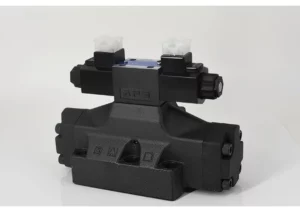
A cylinder has to extend, slow down as it approaches a workpiece, press, and return. Those movements depend on more than pump delivery. Valves route the oil, restrict its flow or regulate pressure at the appropriate point in the circuit. For a buyer, the first useful question is which part of that task the valve must perform.
The five YuciYuken hydraulic valve groups are pressure control, flow control, directional control, stacking and cartridge valves. They are not five mutually exclusive functions. A stacking module, for instance, may regulate pressure. Its stacking construction tells you how it fits into an assembly, while pressure control tells you what it does there.
What a Hydraulic Valve Does
Follow the oil from the pump to the actuator. The pump delivers it into the circuit; a valve selects or regulates the passage through which it reaches a cylinder or motor. At a cylinder, the pressure difference contributes to piston force and the incoming flow affects travel speed. The power still comes from the pump drive.
For the pressing cycle described above, extension and retraction call for different flow paths. Directional control provides that change. Flow control can govern the approach speed, and pressure control can regulate the pressure available during pressing. Looking at the whole cycle makes it easier to see why one machine needs several valve functions.
The Three Main Control Functions
Pressure, flow and directional control address different circuit requirements. Each function has its own role in the machine cycle.
Pressure Control Valves
Inside many pressure control valves, oil pressure acts on a valve element against a spring. A change in that balance moves the element and changes the opening. The connections around it matter: the same broad force balance can be used in valves performing different pressure control tasks.
A relief valve provides a path for fluid when pressure reaches its opening condition, helping limit pressure in the protected part of the circuit. A pressure reducing valve regulates pressure in a downstream branch. These functions are different: limiting supply pressure and maintaining a lower branch pressure require different circuit arrangements.
The YuciYuken pressure control range includes direct acting and pilot operated relief valves among other pressure control products. These names describe different operating arrangements. The appropriate choice depends on the required pressure function, flow and circuit behavior, rather than the word pressure alone.
Flow Control Valves
An actuator that reaches the workpiece too quickly may need a different flow setting, even when its available force is adequate. For a given cylinder area, a lower incoming flow means a slower stroke. Flow control acts on that part of the cycle, regulating the oil passing through the controlled path.
Turning a throttle adjustment changes the opening, but the setting alone does not fix the flow. Pressure difference across the opening and fluid conditions also affect it. A pressure compensated arrangement can reduce sensitivity to changing pressure differences within its operating limits. Check which arrangement is required before expecting constant actuator speed.
The flow control range includes throttle valves, one way flow control valves and needle valves. In a one way arrangement, oil is restricted in one direction and has a check valve path in the other. Install it the wrong way around and the restriction acts on the opposite direction of movement.
Directional Control Valves
Directional control valves connect or isolate passages to start, stop or reverse an actuator. A common double acting cylinder circuit has a pressure supply port, a tank return port and two working ports. Different spool positions connect these ports in different combinations.
Before ordering, examine the center position on the hydraulic symbol. Matching housings and port counts can conceal different center connections, with different effects on unloading and actuator behavior when the command is removed. Also account for internal leakage: a blocked center spool by itself is not a guarantee that a loaded cylinder will stay in place.
Directional control valves include manual, solenoid operated and electrohydraulic designs. A solenoid responds to an electrical command. In a pilot operated design, hydraulic pressure shifts the main stage, so the enquiry must establish the available pilot supply as well as the control signal.
Stacking and Cartridge Arrangements
The construction names overlap with the functional names. Pressure control can be built into a stacking module; directional control can be provided by a cartridge arrangement. Choosing a construction therefore follows the decision about the required function, with installation space and connections then narrowing the options.
Keep the machine action in view as you compare the options. An assembly that fits the available space still has to provide the required oil paths, and its adjustments and service points must remain accessible after installation.
Stacking Valves
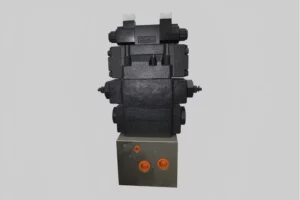
Stacking valves describe an assembly format. Compatible valve modules are arranged between a base and other circuit components, with internal passages carrying fluid through the assembly. Modules can provide pressure control, flow control or check valve functions.
Bringing those passages inside the assembly reduces the external piping between the included functions. There are still interfaces to verify: mounting face, port arrangement, module order and seals. A module that bolts onto the stack is not necessarily suitable for the oil paths in that stack.
Cartridge Valves
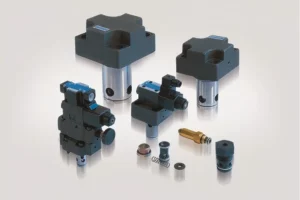
YuciYuken cartridge valves use cartridge elements and covers with pilot passages that can be configured for directional, flow and pressure control. High pressure, high flow circuits are an application area for this range.
Read the cartridge element, cover and pilot circuit as one assembly. Together they establish its installed function. Neither a similar appearance nor the word cartridge establishes a matching cavity or control action; the complete hydraulic symbol and installation details need to agree.
Information to Prepare Before a Valve Enquiry
Send the circuit diagram with the enquiry and mark the function to be controlled. State the flow and working pressure, including relevant return or pilot pressures. The mounting arrangement, fluid and temperature range belong with those details. For an electrical operator, add the voltage, signal and required state after the command is removed.
A replacement enquiry also needs the full existing code, nameplate details and installation drawing. Compare port pattern, spool function, pilot and drain configuration, seals and electrical connections. Stopping at nominal size and maximum pressure leaves several possible mismatches unresolved.
Exploring YuciYuken Valves with TZYY
Discuss the circuit and operating requirements with TZYY before narrowing the enquiry to an individual model. For a new application, describe the movements the machine must make. For a replacement, include the existing assembly details as well. That gives the valve discussion a concrete starting point: the function, construction and connections required by the machine.
FAQs
Q1: What is the difference between a hydraulic relief valve and a pressure reducing valve?
A1: Look at the location of the pressure being controlled. A relief valve opens a discharge path to limit pressure in the protected circuit; a reducing valve regulates a downstream branch. They answer different circuit requirements, even though both are pressure control valves.
Q2: Are stacking valves and cartridge valves separate control functions?
A2: They describe construction and assembly formats. Either format can provide pressure, flow or directional control, depending on its configuration. First identify the control function, then check which assembly format fits the circuit and installation.
Q3: Can YuciYuken hydraulic valves be replaced using only nominal size and pressure rating?
A3: No. A valve can meet both ratings and still have the wrong spool function or connections. Send TZYY the full existing code and circuit drawing, then confirm the mounting face, ports, flow capacity, pilot and drain arrangement, seals and any electrical requirements.